
Choosing Big Bags for Food Manufacturers: 7 Points to Check
What should you check when choosing big bags for food ingredients? Food-contact legislation, migration limits, declaration of compliance, BRC certification, liners and questions for your supplier.
Food ingredients such as flour, sugar, starch, milk powder and spices mostly arrive at the factory in big bags. On that journey the big bag is the packaging in direct contact with the product: a poorly chosen big bag can turn even the best ingredient into a food safety risk.
This guide summarises seven points a food manufacturer should check when choosing big bags (FIBCs) and assessing a supplier.
1. Compliance with food-contact legislation
Any packaging in contact with food must not transfer substances to the food in quantities that could endanger human health.
In the European Union this principle is laid down in the framework Regulation (EC) 1935/2004, and the detailed rules for plastic materials in Regulation (EU) 10/2011. Big bags and their liners are made of polypropylene and polyethylene and therefore fall under this regulation.
The basic limit is this: the total of all substances migrating from the packaging into the food (overall migration) must not exceed 10 milligrams per square decimetre (10 mg/dm²) of food-contact surface. In addition, only substances on the authorised list may be used to manufacture the packaging.
In Turkey the same rules apply under the Turkish Food Codex: the Regulation on Materials and Articles in Contact with Food and the Communiqué on Plastic Materials and Articles in Contact with Food (No. 2019/44).
2. Declaration of compliance and migration tests
Compliance is documented by a declaration. Ask your big bag supplier for:
- Declaration of Compliance (DoC): A signed document stating that the product complies with (EC) 1935/2004 and (EU) 10/2011, and for which food types and under which conditions (time, temperature) it may be used.
- Migration test report: Overall migration and, where required, specific migration analyses carried out by an accredited laboratory.
- Raw material information: Declarations from the raw material producers showing that the polymers and additives used are suitable for food contact.
The conditions of use stated in the declaration must match your product: the type of food (dry, fatty, acidic), the contact time and the temperature.
Read more: Food-Grade FIBC: The EU Declaration of Compliance Explained
3. Food safety certification (BRCGS)
The packaging manufacturer’s food safety management system should be audited by an independent body.
The most widely accepted standard in the packaging industry is BRCGS Packaging Materials (formerly BRC IoP). The grade of the certificate (AA, A, B…) reflects the number of non-conformities found during the audit; AA is the highest grade.
Karaca Ambalaj is certified to BRC IoP grade AA. Read more: BRC IoP Certification: Why It Matters for Food Packaging
4. Hygienic production conditions
Just as important as the certificate is how production is actually carried out. What to look for in food-grade big bag production:
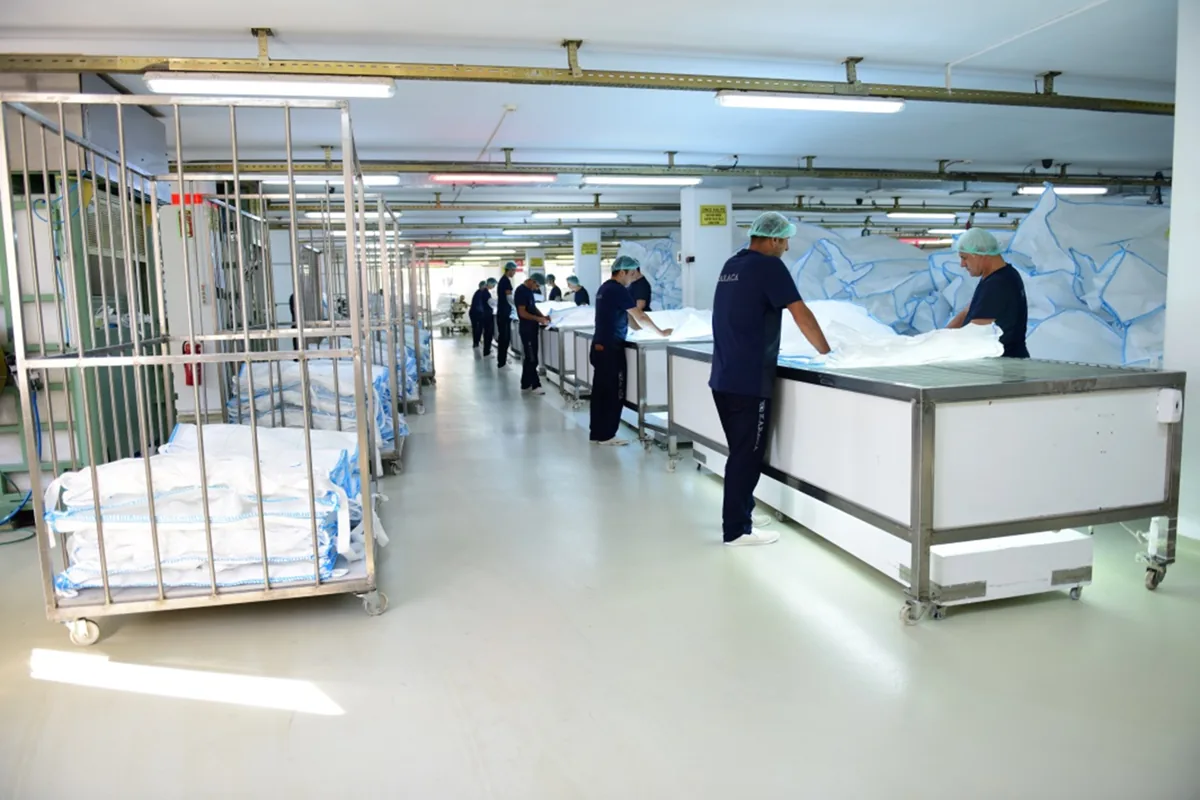
- An enclosed production area with dust and pest control
- A production line dedicated to food-grade products
- Staff hygiene and training
- Cleaning of the inside of the bag at the end of production
At Karaca Ambalaj:
- Production takes place in a 5,000 m² enclosed area.
- The safety and cleanliness of the production site and the outdoor area are checked and approved regularly.
- Raw materials, chemicals, packaging materials and finished goods are stored separately, each under its own conditions.
- After periodic technical maintenance the area is cleaned to eliminate the risk of contamination; external maintenance contractors are audited as well.
- Regular pest control is carried out.
- As the final step, the inside of food bags is cleaned by vacuuming.
5. The right big bag and liner for the product
Every food ingredient has different needs. The questions that determine the choice:
| Product property | Effect | Typical solution |
|---|---|---|
| Does it attract moisture? (sugar, milk powder, starch) | Caking, spoilage | Moisture-barrier liner (LDPE / HDPE) |
| Does it have aroma or fat? (cocoa, spices, coffee) | Aroma loss, oxidation | Oxygen and aroma barrier liner (EVOH) |
| Is it a very fine powder? (flour, starch) | Dust sifting through seams | Coated fabric, sift-proof seams, liner |
| Does it need to breathe? (in-shell hazelnuts, walnuts) | Moisture build-up, mould | Ventilated big bag |
| Will it be stacked in the warehouse? | Use of space | Q-Bag (form-stable) |
For liner options see: FIBC Liner Types: LDPE, EVOH and Aluminium Barrier Guide
Recommendations for your product: sugar, flour, starch, milk powder, cocoa, coffee, salt, spices, hazelnuts and nuts, cornflakes.
6. Traceability and recall
When a problem occurs, you need to be able to find out within minutes which batch is affected. Your supplier should have:
- Traceability of every big bag down to its production lot
- Retention of production records
- Retained samples
- A written recall procedure
At Karaca Ambalaj:
- Production is recorded; a retrospective review can be carried out after delivery.
- Order details are kept for the shelf life of the product, and production samples (retained samples) for 6 months.
- In the event of faulty production, the product recall process is initiated.
7. Questions to ask your supplier
- Do you hold a current BRCGS Packaging (or equivalent) certificate, and at what grade?
- Can you provide a declaration of compliance with (EC) 1935/2004 and (EU) 10/2011 for my product?
- Which laboratory carried out the migration tests, and when?
- Are food-grade products manufactured on a separate line?
- Do you have lot-based traceability and a recall procedure?
- How long do you keep retained samples?
- Which liner and which big bag type do you recommend for my product, and why?
Conclusion
Karaca Ambalaj has been manufacturing big bags for the food industry in Turkey since 1998 and exports 98% of its production, mostly to Europe.
Contact us for the right big bag for your product and the documents you need.
Frequently Asked Questions
FAQ on This Topic
What is the difference between a food-grade big bag and a standard big bag?
What is the migration limit for food packaging?
Which documents should I request from my big bag supplier?
Does every food product need a liner?
Related Industry Solution
Explore SolutionsRelated Articles
PPWR and FIBC Big Bags: What the EU Packaging Regulation Means for Bulk Bag Buyers
The EU Packaging and Packaging Waste Regulation (PPWR) has applied since 12 August 2026. Which documents should you request from your big bag supplier? Heavy metal and PFAS limits, declaration of conformity, 2030 targets.
Food-Grade FIBC: The EU Declaration of Compliance Explained
What is the declaration of compliance requested with food-grade big bags? What (EC) 1935/2004 and (EU) 10/2011 require, what the declaration must contain and how migration tests are carried out.
What is FIBC? Comprehensive Big Bag Guide
Comprehensive guide to FIBC (Flexible Intermediate Bulk Container) also known as big bags. Types, applications, safe working load capacities and selection criteria.